Get Involved - Spelman Students
Research Opportunities for Students
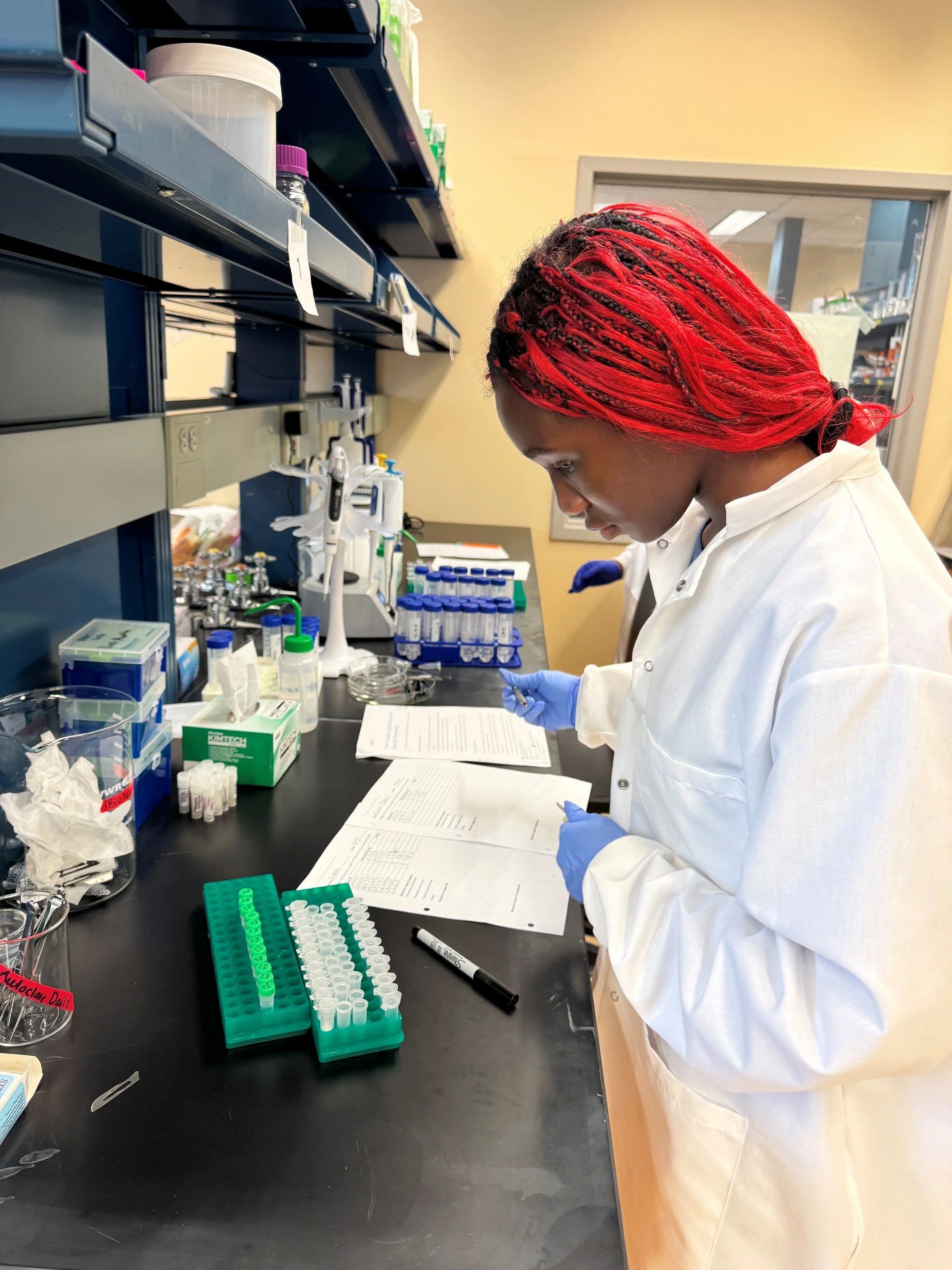
Our lab uses field ecology, genomics, and bioinformatics to understand how wildlife and plant populations respond to environmental change—and how genetic information can support their conservation. Undergraduate researchers may participate in fieldwork, laboratory research, data analysis, or a combination of these activities.
Prior research experience is not required. We are especially interested in working with students who are curious about conservation, ecology, evolution, genetics, or environmental change and who can commit consistently to a research project.
Diamondback Terrapin Conservation Genomics
Diamondback terrapins are turtles that inhabit coastal salt marshes and estuaries. In collaboration with Zoo Atlanta and other conservation partners, we are studying the genetic diversity and family relationships of terrapins involved in a head-start program.
Our current work uses reduced-representation genomic sequencing to discover genetic markers and develop a targeted SNP panel. These tools will allow us to examine parentage, relatedness, paternal diversity, and the effective number of breeding adults contributing to the population. Ultimately, this research will help evaluate the genetic outcomes of conservation breeding and head-start efforts.
Students involved in this project may gain experience with:
DNA extraction and quantification
PCR and genomic library preparation
ddRAD sequencing and SNP discovery
Targeted amplicon sequencing
Quality control and management of genomic data
Parentage, relatedness, and population-genetic analyses
Scientific communication and collaboration with conservation partners
Conservation Genomics of the Miccosukee Gooseberry
The Miccosukee gooseberry (Ribes echinellum) is a federally threatened plant found in only a small number of populations. In collaboration with the Atlanta Botanical Garden and other conservation partners, we are investigating how genetic variation and fine-scale environmental conditions influence its survival and reproduction.
Our research combines long-term monitoring of flower and fruit production, measurements of soil and microclimate conditions, reciprocal-transplant experiments, and whole-genome resequencing. We are using these data to investigate local adaptation, demographic history, inbreeding, and relationships among genotype, environment, and plant fitness. The results can help guide propagation, seed banking, population management, and future restoration efforts.
Students involved in this project may gain experience with:
Monitoring plant survival, flowering, and fruit production
Collecting ecological and microclimate data
Using environmental sensors to measure temperature and soil moisture
Conducting reciprocal-transplant and common-garden experiments
Extracting and assessing DNA
Processing whole-genome sequencing data
Analyzing genetic diversity, inbreeding, and demographic history
Testing relationships among genomic, environmental, and fitness data
Communicating results to scientific and conservation audiences
Tools and Approaches
Depending on the project and their interests, students may work across several areas:
Field ecology: Plant and wildlife monitoring, ecological measurements, experimental transplants, environmental sensors, sample collection, and data management.
Genomics and molecular biology: DNA extraction, PCR, library preparation, DNA quantification, sequencing, and laboratory quality control.
Bioinformatics and data analysis: Sequence-quality assessment, alignment to reference genomes, variant discovery and filtering, population-genetic analysis, genotype–environment analysis, reproducible coding, and data visualization.
Interested in Joining the Lab?
Students interested in research should complete the [Student Research Interest Form]. The form asks about your scientific interests, reasons for pursuing research, availability, and ability to commit to a project.
Research positions depend on current projects, available mentorship, funding, and the fit between a student’s interests and the needs of the lab. Students who appear to be a strong match may be invited to meet and discuss possible opportunities.